Choosing a luxury watch winder comes down to three decisions, not one: how precisely it winds, how it balances display against security, and how it fits your interior. The single most consequential feature, according to retailers and manufacturers in the space, is programmability — the ability to set exact Turns Per Day (TPD) and rotational direction for each watch. A Rolex Submariner, for example, may require around 650 TPD bidirectionally, while a Breitling may need roughly 800 TPD clockwise, per guidance from winder maker BezelHold. This guide walks through each dimension and closes with a decision framework you can apply to any brand or model.
Understanding the Core Purpose of a Luxury Watch Winder
A watch winder exists to keep automatic movements powered when they are not being worn. Continuous rotation ensures the self-winding mechanism stays wound, which matters most for collectors with multiple watches in rotation or pieces with complex complications such as perpetual calendars that are tedious to reset. Fink's Jewelers frames the purchase as an "extremely personal and game-changing choice" and cautions against buying the first winder you see, since many companies claim to offer the best on the market.
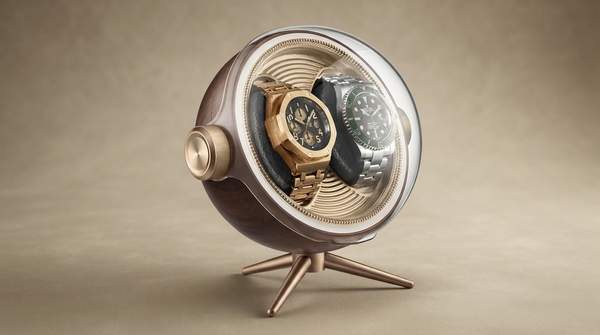
The purpose also extends beyond function into presentation. A high-end winder typically features a clear viewing window that lets you admire the timepiece while it spins, as Diamond Source NYC describes, with exterior materials ranging from polished wood to modern resin finishes. In other words, a luxury winder is simultaneously a machine, a display case, and a piece of furniture — which is why evaluating one requires more than a single criterion.
Dimension 1: Winding Mechanism — Precision vs. Basic Rotation
Not all automatic movements wind the same way, and this is where luxury winders earn their price. A high-end winder allows you to program the exact rotational direction — clockwise, counter-clockwise, or bi-directional — and TPD for each individual watch. BezelHold's guidance gives concrete examples: a Rolex Submariner at roughly 650 TPD bidirectional, a Breitling at around 800 TPD clockwise. Fink's Jewelers is blunt about priorities: "the programmable settings are the most important feature to consider."
Rest periods matter too. The best winders do not spin constantly; they run in cycles, winding the watch and then "sleeping" to let the mainspring uncoil slightly, which BezelHold says mimics natural human wear and prevents unnecessary tension on the movement.
The contrast with budget models is stark. Holme & Hadfield warns that generic winders in the $30 to $80 range share the broad outlines of a winder — a motor, a rotation cycle, a case — but "differ in every specification that matters": unverified magnetic output, single fixed TPD settings, and motors that become noisy within months. Their conclusion for a serious piece: the wrong winder can cause damage that costs far more to fix than the winder saved.
Dimension 2: Security & Display — Showcase vs. Safe
The second dimension is a trade-off between showing your watches and protecting them. On the display side, winders are designed to showcase rather than hide: front-opening display cases are highly popular among collectors, and designs that display the watches they wind — rather than concealing them — are an explicit design goal for some makers, including Holme & Hadfield, whose brief included a winder that "displays the watches it winds rather than hiding them."
On the security side, features vary by model and brand. Mercier & Fils, for instance, equips its Mazarin line with a signature key lock system, while WatchMatic — whose founder specializes in luxury watch safes and bespoke high-security storage — points collectors with serious holdings toward dedicated luxury watch safes with advanced fire protection and structural integration. The right position on this spectrum depends on the value of your collection and your own risk assessment: a modest two-watch collection on a nightstand has different needs from a two-dozen-piece assemblage in a walk-in closet.
Dimension 3: Aesthetic Integration — Traditional vs. Modern Design
Because a winder lives in your home, its materials and design language are a legitimate selection criterion — though it is worth stating plainly that aesthetics are distinct from winding function. On the traditional end, Mercier & Fils describes its Mazarin collection as integrating into classic interiors — wood paneling, antique furniture, wooden floors — where it "blends in naturally without creating a contrasting effect," with the key lock system extending that heritage coherence. The line offers capacities of 2, 6, 12, and 24 slots.
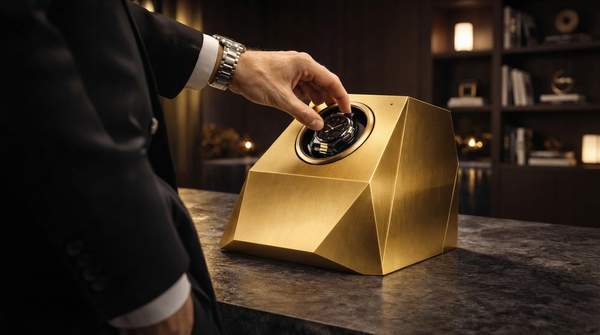
On the modern end, BezelHold favors a minimalist, architectural ethos that avoids what it calls the gaudy, overly technical look of many competitors, while Diamond Source NYC notes resin finishes as a contemporary alternative to polished wood. BezelHold also flags a practical detail that bridges aesthetics and function: cheap rigid plastic cushions can stretch leather straps or fail to secure heavy watches, so cushion quality deserves attention alongside cabinetry.
How to Match a Winder to Your Watch Collection
Start with your watches, not the winder. For each automatic piece you plan to keep wound, find its manufacturer-recommended TPD and winding direction — this information is typically available from the watchmaker or winder manufacturers' setting guides, and this article deliberately does not attempt an exhaustive database of settings for all brands. Then check that the winder you are considering can be programmed to those values independently for each watch, especially if your collection mixes movements with different requirements.
Next, size the capacity honestly. A collector with two important pieces needs a different machine — Mercier & Fils describes its compact two-slot model as "a more classic approach to the prestige winder" — than one with a dozen watches in rotation. Finally, weigh motor quality and noise: Holme & Hadfield developed its winder over 18 months and more than ten design iterations with input from thousands of collectors, specifically to operate silently enough to sit beside a bed, using Japanese Mabuchi motors tested below 1 Gauss for magnetic safety.
Luxury Watch Winder Decision Framework
The matrix below organizes the features you should evaluate into the three core dimensions, so you can prioritize and make trade-offs based on your own needs for technical precision, security, and design. Work through each row and ask which side of the trade-off your collection and home demand.
| Feature to evaluate | Dimension | What to look for | Trade-off to weigh |
|---|---|---|---|
| Programmable TPD and direction | Winding Mechanism | Adjustable Turns Per Day and clockwise, counter-clockwise, or bi-directional rotation set per watch | Different movements require specific settings; fixed programs can be unsuitable for complex calibres |
| Rest periods and motor quality | Winding Mechanism | Cyclical winding with sleep phases; quiet, low-magnetism motors (e.g., tested below 1 Gauss) | Constant rotation adds unnecessary tension; noisy motors are unsuitable for bedrooms |
| Security features | Security & Display | Key locks, robust construction, or a dedicated watch safe for high-value collections | More security can mean less visibility; match the feature to collection value and risk |
| Display style | Security & Display | Glass viewing windows, front-opening cases, internal lighting | Showcasing versus concealing is a personal choice tied to how you live with the collection |
| Materials and craftsmanship | Aesthetic Integration | Solid wood, piano-gloss lacquers, tempered glass, premium leather or microfiber interiors, quality cushions | Materials affect longevity and interior harmony, not winding precision |
| Design language | Aesthetic Integration | Traditional polished-wood styles through minimalist architectural forms and resin finishes | Choose the style that harmonizes with your existing decor |
Applying the matrix yields a recommendation about the type of winder that suits you. If your collection includes complex movements or mixed calibres, prioritize full programmability and accept nothing less than per-watch TPD and direction control. If security concerns dominate — high value, shared living spaces — lean toward lockable or safe-integrated designs over open display. If the winder will occupy a visible place in a designed interior, let the materials and design language carry the decision, provided the mechanism already meets your technical floor.
Making Your Informed Watch Winder Choice
Select a luxury watch winder that precisely matches your automatic watches' winding requirements (TPD and direction), provides appropriate security for your collection's value, and aesthetically complements your interior design. The optimal balance will vary based on individual collection value, wearing habits, and personal style — there is no single best winder, only the best fit for your circumstances.
The measurable indicator of a good choice is concrete: the chosen winder consistently keeps your watches wound to the correct time and date, integrates seamlessly into your living space, and offers peace of mind regarding security. If any of those three conditions fails — a watch repeatedly stopping on the correct settings, a machine that clashes with the room, or lingering worry about protection — the framework above tells you which dimension to revisit before replacing the whole unit.
Sources
- The Ultimate Guide to Finding the Best Luxury Watch Winder for Your Collection — BezelHold
- Invest in an Automatic Watch Winder to Keep Your Designer Timepieces Ticking — Fink's Jewelers
- Best Watch Winder for Rolex: Luxury Winders & Settings — Diamond Source NYC
- Best Watch Winder for Automatic Watches in 2026 — Holme & Hadfield
- The best automatic watch winders in 2026 — Mercier & Fils
- The Complete 2026 Guide to Watch Winders, Settings, Safety & Collector-Level Decisions — WatchMatic