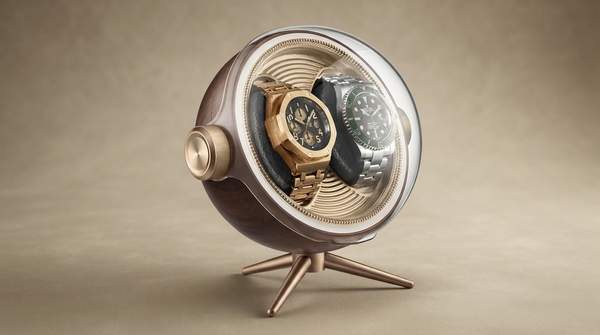
Choosing a luxury watch winder is a decision that extends beyond mere convenience. For the owner of automatic timepieces, the right winder is an essential tool for preserving the mechanical health, accuracy, and intricate functions of their collection. The ideal choice is not a one-size-fits-all solution but rather a careful match between the winder’s technical capabilities, capacity, and design with the specific needs of your watches.
Why a Luxury Watch Winder is Essential for Your Collection
While an automatic watch is designed to be powered by the motion of its wearer, a high-quality winder becomes indispensable when a timepiece is not in daily rotation. Its primary function is to keep the watch running, which maintains the distribution of lubricants within the delicate movement and prevents them from congealing. This consistent operation helps preserve the watch's accuracy and long-term health, saving you from the inconvenience of frequent manual winding and adjustments.
The value of a winder is particularly evident for watches with sophisticated complications. According to SwissKubik, timepieces featuring perpetual calendars, moon phases, or dual time zones are especially sensitive to stopping. A winder keeps these complex functions synchronized, avoiding the need for intricate resetting procedures that might otherwise require the intervention of a professional watchmaker. For a collector, this means your watches are always ready to wear, displaying the correct date, time, and astronomical information.
Understanding Turns Per Day (TPD) and Rotation Direction
The core of a luxury watch winder's function lies in its programmable settings, which must be tailored to the specific requirements of each watch movement. The two most critical settings are Turns Per Day (TPD) and rotation direction. TPD refers to the number of full rotations the winder makes in a 24-hour period to keep the watch's mainspring sufficiently wound.
According to the winder manufacturer MODALO, most automatic watches, including popular models from Rolex and Omega, typically require between 650 and 900 TPD. The rotation direction—clockwise, counter-clockwise, or bi-directional—is also dictated by the watch's specific caliber. For instance, MODALO and other sources note that many luxury watches from brands like Rolex and Patek Philippe often recommend bi-directional winding. The Rolex Daytona's 4130 caliber, for example, winds in any direction and needs at least 650-800 turns per day to remain fully wound.
A premium winder allows for precise programming of both TPD and direction, ensuring it never overwinds a timepiece. As explained by Diamond Source NYC, automatic movements have a built-in safety clutch to prevent damage, and high-quality winders use internal programming to pause rotation once the watch is wound, protecting the mechanism over the long term.