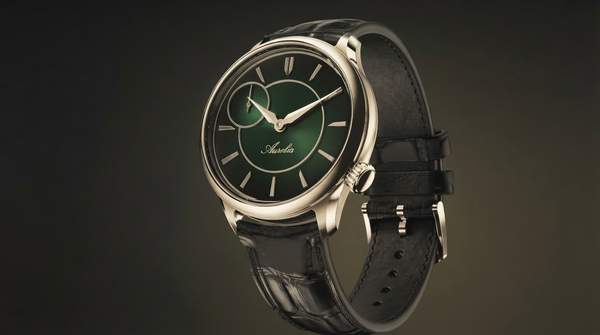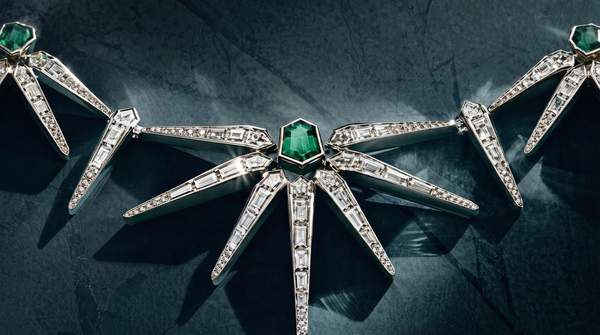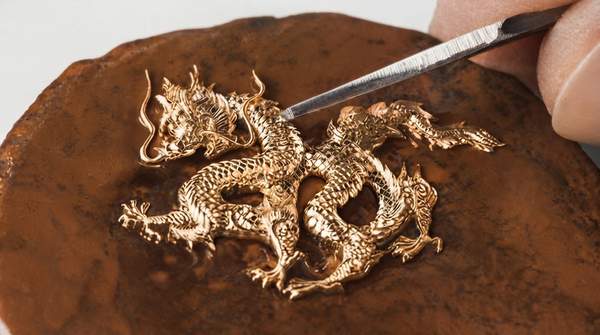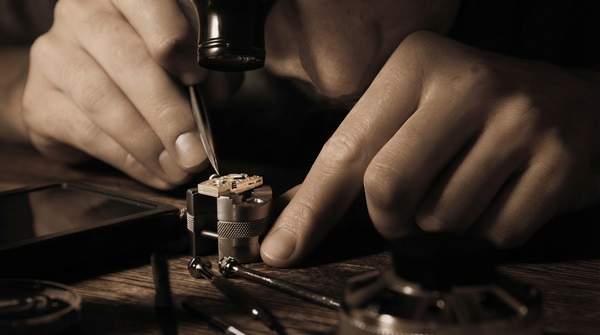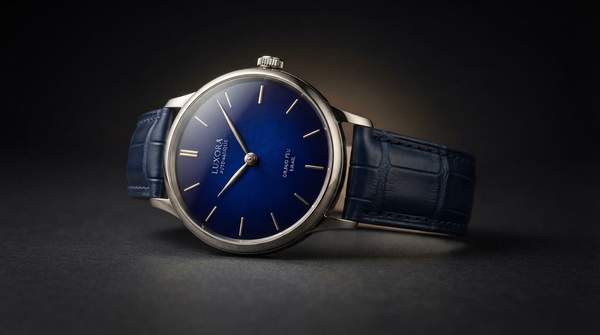
The three great enameling techniques used on watch dials are distinguished by one thing above all: how the cells that hold the molten glass are created. In cloisonné, thin gold or silver wires are laid onto a solid base to form compartments; in champlevé, the cells are carved directly into the metal dial itself; and in plique-à-jour, the enamel is suspended in cells with no permanent backing at all, producing a translucent, stained-glass effect. Recognizing which technique a dial uses—and which metal lies beneath the enamel—is the key to understanding why these dials are rare, expensive and prized by collectors.
The Enduring Art of Enameling in Haute Horlogerie
Enamel is a vitreous material made of minerals combined with metal oxides for color, fused to a metal base through repeated firing. Girard-Perregaux, whose Donzé Cadrans workshop has specialized in enamel dials since 1972 and is widely regarded within the watch industry as the go-to specialist for traditional enamel work, notes that the various methods cannot be automated, so roughly ninety percent of all work is done by hand—the only means, the manufacture says, of achieving the required precision. That constraint is precisely what keeps enameling within the preserve of haute horlogerie, where it is prized as one of the Métiers d'Arts beloved by collectors.
Patek Philippe describes the same reality from the artisan's bench: dozens of firings may be needed as multiple layers are built up, with a final coat of transparent enamel adding depth and brilliance. The enameler's toolkit, the Geneva manufacture explains, must be learned over the course of an entire career. The craft rewards a confident hand, deep familiarity with the raw materials and, as the Fondation de la Haute Horlogerie puts it, mastery of "the art of fire."
Historical Roots and Modern Rarity of Enamel Dials
Enameling is an ancient decorative art. The Fondation de la Haute Horlogerie traces enamel artifacts to gold objects with pâte de verre embellishments and statues inlaid with enamel in ancient Egypt and, later, Greece—roughly four thousand years of continuous practice across all manner of decorative objects. A. Lange & Söhne, which places the art at about 3,500 years old, recalls that Augustus the Strong, the Elector of Saxony, was a devotee of the technique, and that his court jeweler, Johann Melchior Dinglinger, created precious enamel pieces now displayed in the Green Vault in Dresden's castle.
The horological connection is just as old and more direct: A. Lange & Söhne notes that enameling was once used very frequently for pocket watch dials. Today, the same manufacture reports, very few experts remain skilled in this highly complicated process, so enameled dials are very rarely found in wristwatches. Revolution Watch attributes the modern rarity to economics as much as skill: enamel was once commonly practiced before industrial methods of mass production and the pursuit of maximum profit displaced it. The result is that enamel now appears almost exclusively on watches carrying a hefty price tag, leaving many enthusiasts unsure how to tell cloisonné from champlevé or how to judge a quality dial.
Comparative Guide to Enameling Techniques
The table below contrasts the major techniques by their defining feature: how the enamel-holding cells are made. Grand Feu is included as a process rather than a style, since it underlies several techniques. Use the "How the cells are made" column to identify a technique from the dial's construction itself, and the appearance column to confirm what you see on the wrist.
| Technique | How the cells are made | Resulting appearance | Relative complexity |
|---|---|---|---|
| Grand Feu (process) | Not a style but a firing process: enamel powder is washed, mixed with water, applied to the prepared surface and fired at 850°C to fuse to the metal base | A durable, glossy surface; a final coat of transparent enamel adds depth and brilliance | Dozens of firings may be needed as layers build up; the process underpins other techniques |
| Cloisonné | Gold or silver wire is bent to trace the design and secured to the base with an adhesive that disappears during firing, forming cells | The wires remain visible, defining the boundaries of each enamel color on a solid backing | High; successive layers of enamel are applied inside the cells to obtain the required volumes and colors after multiple firings |
| Champlevé | The dial itself is carved, milled or etched, leaving raised metal walls and ridges that define the composition | Enamel fills the carved recesses; the raised metal forms the design's outlines | High; the oldest enamelling technique and among the most technically demanding |
| Plique-à-jour | A derivative of cloisonné: cells are backed temporarily with copper foil, or supported by a glass back, which is removed after firing—by a light tap or dissolved with acid | Translucent enamel with no metal backing; light passes directly through, revealing what lies beneath | Very high; the temporary backing must be removed without damaging the fired enamel |
The core distinction is structural, and it is worth stating plainly. Cloisonné adds partitions to a smooth base; champlevé cuts them into the base; plique-à-jour keeps the partitions but discards the base. Once you grasp this, identification becomes visual: visible wires mean cloisonné, carved depressions with raised metal ridges mean champlevé, and light passing through the dial means plique-à-jour. The Fondation de la Haute Horlogerie notes that filling cells with enamel and fusing it in successive firings is common to both cloisonné and champlevé—the difference lies entirely in whether the cells were added or excavated.
Other named techniques extend the same grammar. Patek Philippe describes paillonné enamel, in which tiny gold-leaf spangles are embedded within layers of transparent enamel, and miniature painting on enamel, a rare technique in which the enamel is mixed with lavender oil rather than water and applied with a very fine brush. Guilloché enameling, as the antiques house M.S. Rau explains, applies enamel over an engine-turned engraved pattern in the metal base—a texture-based approach popularized in the Victorian era and closely associated with Fabergé.
The Grand Feu Process: A Foundation of Enamel Artistry
Grand Feu refers to the firing process rather than a decorative style, and it is the foundation on which the others rest. Patek Philippe describes how the powder is washed and mixed with water so the mixture can be applied to carefully prepared surfaces; once dry, the paste is fired at 850°C to form an impregnable surface that fuses to the metal base. Girard-Perregaux and the Fondation de la Haute Horlogerie both emphasize that this cannot be done by machine—the precision required leaves no substitute for the human hand.
The firing is where dials are lost. Revolution Watch notes that steel tends to crack under repetitive firings, which is why it suits single-color dials but not cloisonné work. Even the dial's feet—the posts that secure it within the watch—must be soldered to the back of the blank with care, because excessive tightening can distort the blank and lead to enamel cracking during firing. A single dial may require dozens of firings, and each one risks the entire piece. This is part of why A. Lange & Söhne says the process of making an enameled dial takes several days, during which the different steps have to be repeated again and again.
Impact of Base Materials on Enamel Dials
The metal beneath the enamel shapes both the process and the market position of the finished watch. Revolution Watch reports that watchmakers such as Seiko have adopted copper and steel as base materials for their enamel dials. Steel offers rigidity and resistance to oxidation during firing, but its inherent stiffness makes it better suited to mass production of single-color enamel dials—and its tendency to crack under repeated firings renders it unsuitable for cloisonné enamel work.
At the other end of the market, champlevé cells are engraved, milled or etched into bases of copper, silver or gold—precious metals whose working properties suit the fine detail the technique demands. The choice of base is therefore a reliable signal of a watch's positioning: steel and copper underpin accessible single-color dials, while silver and gold bases belong to the high-luxury segment where multi-firing techniques like cloisonné and champlevé are feasible. The base material also interacts with technique: a metal that cannot survive repeated firings cannot carry a cloisonné design, however skilled the enameler.
Enameling's Contribution to Collectible Value
Value in enamel dials follows from scarcity of skill. Girard-Perregaux states that because the methods cannot be automated, enameling remains a highly prized Métiers d'Arts beloved by collectors. A. Lange & Söhne's observation that very few experts remain skilled in the process explains why enameled dials appear so rarely in wristwatches—and why they command attention when they do. Revolution Watch frames the same point from the buyer's side: enamel is typically reserved for watches that come with a hefty price tag, and its rarity has rendered it somewhat enigmatic even to enthusiasts.
The technique itself also signals rarity. Plique-à-jour, for example, appears in pieces like the Vacheron Constantin Métiers d'Art Les Aérostiers, which Revolution Watch cites as an exquisite example: its translucent enamel reveals the quadruple rotating time-telling disks beneath. Champlevé, meanwhile, appears in the Métiers d'Art collections of major manufactures and in Jaeger-LeCoultre's Hybris Artistica and Atelier Reverso programs, where the Reverso's reversible case presents the enamel work as a primary decorative face. The more firings and the more delicate the cell work, the higher the risk of loss—and the greater the collectible interest in the dials that survive.
Appreciating the Art of Enamel Dials
When evaluating a luxury timepiece with an enamel dial, collectors should consider the specific enameling technique used, the base metal, and the overall craftsmanship, as these factors significantly influence its aesthetic appeal, complexity, and collectible value. The measurable indicator is the presence of distinct wire outlines (cloisonné), carved depressions (champlevé), or a stained-glass effect without a backing (plique-à-jour) on a watch dial. Learning to spot these three signatures turns a dial from an anonymous colored surface into a legible record of how it was made—and of how much human labor survived the fire to reach the wrist.
Sources
- The Art of Enamelling — Girard-Perregaux (United States)
- The Art of Enameling at Patek Philippe — Patek Philippe SA
- FHH | Enameller: Mastering the Art of Enamel Decoration
- THE ART OF ENAMELLING — ALANGE SOEHNE
- Understanding Métiers d’Arts: Enameling — Revolution Watch
- History of Enameling Techniques — M.S. Rau