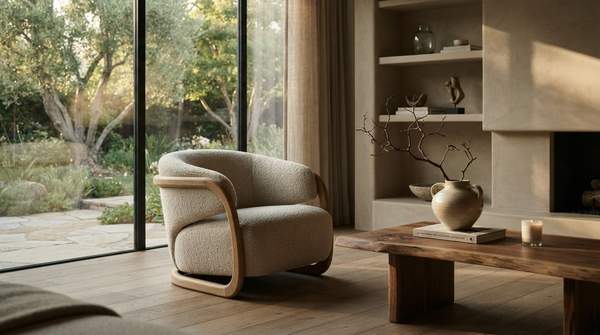
Sustainable luxury interior design succeeds when it stops being a shopping list of "green" products and becomes a systematic way of evaluating every choice. The American Society of Interior Designers describes this as a holistic approach that goes beyond material selection to encompass chemical use, energy efficiency, waste reduction, and ethical sourcing. For the affluent homeowner, this shift is liberating rather than restrictive: high-end projects have the budget and craft to pursue verifiable sustainability without sacrificing beauty, as designer Victoria Yakusha's own material development demonstrates.
The Holistic Framework: Four Pillars of Sustainable Design
The core insight from the design profession is that eco-friendly materials alone do not create a sustainable interior. ASID frames truly sustainable design as producing spaces that are healthy both for the environment and for the people who occupy them. That definition deliberately widens the lens: a marble slab may be natural, but its extraction, transport, and end-of-life disposal all carry environmental weight. Writing for the Opal Group, Leo Bohol similarly identifies eco-friendly materials, responsible sourcing, and space efficiency as the core principles of eco-conscious design, noting that aesthetics and sustainability are complements rather than rivals.
These perspectives collapse naturally into four pillars that can structure an entire project: material sourcing and lifecycle, energy efficiency and technology, waste reduction and longevity, and ethical and health impact. Each pillar generates its own questions and, critically, its own verifiable standards, which we consolidate later in this article.
Pillar 1: Material Sourcing and Lifecycle
The first pillar asks where a material comes from and what happens to it at every stage of its existence. Guidance from sustainable-design practitioners points to natural, responsibly sourced materials—wood, stone, bamboo, and cork—as foundations of low-impact interiors that nonetheless deliver warmth and organic beauty. Bamboo earns particular attention as a quickly renewable resource, and extraction practices matter as much as the material itself.
Recycled and upcycled products form a second tier: reclaimed wood, recycled glass, and repurposed textiles reduce waste and avoid the demand for new raw resources. The evaluation principle that governs this pillar is lifecycle thinking. As one design guide puts it, the environmental impact of materials must be evaluated from extraction, production, transportation, and processing all the way to how they are discarded after use. A homeowner applying this pillar to flooring, for example, would compare not only appearance but the full journey of each option.
Pillar 2: Energy Efficiency and Advanced Technology
ASID names energy efficiency as a key component of its holistic approach, and the luxury market has made this pillar a signature feature rather than a compromise. According to the design publication by Angelica Angeli, solar panels paired with battery storage are becoming essential features in high-end homes seeking self-sufficiency, allowing homeowners to significantly reduce their carbon footprint while maintaining uninterrupted power.
Aesthetics need not be sacrificed to achieve this: some luxury residences now incorporate solar roof tiles that blend with the architectural envelope without compromising efficiency. The practical benefit, Angeli notes, is twofold—lower energy bills and improved indoor comfort. Bohol's commentary adds passive solar heating and energy-efficient appliances to the toolkit of the eco-conscious homeowner. In the context of a renovation, this pillar typically intersects with window placement, glazing, and lighting specification, decisions where energy performance and design quality reinforce one another.
Pillar 3: Waste Reduction and Longevity
The third pillar addresses time. Sustainable design favors interiors that remain relevant and functional for many years, reducing the need for frequent updates or replacements—a point Yakusha's practice illustrates through furniture designed to stand the test of time. Her signature composite material, ZTISTA, made from natural elements like stone and wood, was developed explicitly to combine sustainability with aesthetic appeal without compromising beauty or performance.
Longevity operates alongside circular practices. Products that can be recycled or biodegraded at end of life, and existing items that can be repurposed, form the practical core of waste reduction in a project. For a luxury renovation, this pillar translates into concrete decisions: reusing salvaged architectural elements, specifying pieces built to be repaired rather than replaced, and planning for how each element leaves the home eventually, not just how it arrives.
Pillar 4: Ethical and Health Impact
The final pillar concerns people. ASID's holistic definition pairs environmental health with occupant health, and its framework explicitly includes chemical use among the considerations that extend beyond material choice. A finish that is beautiful but off-gasses harmful compounds fails the holistic test; a textile that is natural but produced unethically fails it too. Ethical sourcing of interior projects sits alongside energy and waste as a foundation of genuinely eco-friendly design, according to ASID's account.
Bohol's observations on ethical product sourcing confirm that this dimension reflects a growing interest in eco-friendly solutions for homes and workspaces. For the homeowner, the pillar asks two questions of every purchase: does this product support a healthy interior for the people living in it, and was it produced under conditions the buyer would endorse?
Sustainable Luxury Design Decision Framework
The framework below consolidates the four pillars into a reusable matrix. To use it, take any design element under consideration—a floor, a sofa, an appliance—and ask the questions in each row. A strong sustainable profile requires satisfactory answers across all four; a weak answer in one pillar is a signal to press the supplier, seek an alternative, or consciously accept the trade-off.
| Pillar | Key Consideration | Questions to Ask | Verification Standard |
|---|---|---|---|
| Material Sourcing & Lifecycle | Natural, recycled, or upcycled materials with low environmental impact—wood, stone, bamboo, cork, reclaimed wood, recycled glass, repurposed textiles | Where was this extracted or produced? How was it transported and processed? What happens to it at end of life? | FSC label for wood; Cradle to Cradle certification |
| Energy Efficiency & Technology | Renewable energy integration such as solar panels with battery storage; passive solar heating and energy-efficient appliances | Will this element reduce the home's energy demand or support self-sufficiency? Does it maintain comfort and aesthetics? | Specified product performance and installer documentation |
| Waste Reduction & Longevity | Durable designs that stay relevant for years and avoid frequent replacement; items that can be recycled, biodegraded, or repurposed | How long will this last both physically and aesthetically? Can it be repaired, repurposed, or responsibly discarded? | Manufacturer longevity and end-of-life information |
| Ethical & Health Impact | Spaces healthy for occupants and environment; attention to chemical use and ethical production | Does this product support healthy indoor air and occupant well-being? Were workers treated and paid fairly? | Fair Trade certification |
The matrix rewards honesty. A product scoring well on materials but poorly on ethics is not a sustainable choice overall—it is a partial one, and the framework makes that visible before purchase rather than after.
Verifying Sustainability: Key Certifications to Look For
Because sustainability claims are easy to make and hard to check, third-party certification is the homeowner's strongest defense against unsubstantiated green marketing. ASID identifies three certifications as providing assurance that materials are sourced responsibly: FSC, Cradle to Cradle, and Fair Trade. The FSC label on wood products, as one design guide explains, ensures the wood was harvested sustainably. Labels, standards, and certifications of this kind give credible information about a product's origin and help buyers identify genuinely eco-friendly products.
Each certification answers a different pillar. FSC speaks to responsible forestry and the sourcing pillar. Cradle to Cradle addresses the lifecycle question—how a product is made and what happens after use. Fair Trade verifies the ethical dimension of production. Asking suppliers directly which certifications their products carry, and requesting documentation, converts the framework from theory into practice at the point of sale.
Making Informed Sustainable Luxury Choices
Homeowners can confidently integrate sustainable practices into luxury interior design by applying a holistic framework that evaluates materials, energy, waste, and ethics, supported by verifiable third-party certifications. The distinction between eco-luxury and green marketing rarely lies in appearance; it lies in whether claims can be verified through FSC, Cradle to Cradle, or Fair Trade standards and whether the full lifecycle of a product has been considered. A useful measure of success is increased selection of certified sustainable luxury products and design elements in project plans: as your specification list fills with items that pass all four pillars of the framework, sustainability stops being a constraint on luxury and becomes part of its definition.
Sources
- American Society of Interior Designers — ASID
- Sustainable Interior Design: Principles and Materials — Victoria Yakusha
- Sustainable Interior Design: Embracing Eco-Friendly Practices for a Healthier Planet — Opal Group
- Luxury Meets Sustainability: Eco-Friendly Interior Design Trends — Angelica Angeli
- ECONYL