A sustainable luxury home is not defined by a single solar array or a marketing brochure's use of the word "green." According to the Abu Dhabi-based developer Aldar, which documents how sustainable design now leads its luxury segment, genuine environmental performance rests on a set of interlocking choices: passive design that works with the site's sun and wind, energy systems that cut waste without sacrificing comfort, water recycling, long-lasting low-emission materials, and interiors that connect occupants to nature. For a buyer, these choices can be sorted into five pillars — site and passive design, energy, water, materials, and well-being — that turn vague claims into a checklist you can actually interrogate.
Site & Passive Design: Harmonizing with Nature
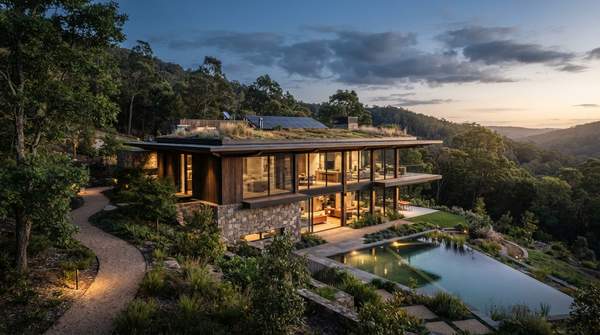
The most consequential sustainability decisions in a luxury home are made before a single wall is built. Aldar describes site orientation as a planning exercise in which a building is aligned with seasonal sun paths and wind directions, so that daylight and natural shading do the work that artificial lighting and mechanical cooling would otherwise perform. This is passive design: comfort engineered into the geometry of the property rather than bolted on as equipment.
In practice, orientation determines how much sun enters living spaces in summer versus winter, how naturally air moves through the floor plan, and how much of the day a home can function without electric light. Aldar notes that these choices support long-term energy savings while making homes feel more connected to their surroundings — an aesthetic benefit and an environmental one arriving through the same decision. When evaluating a property, the question to ask a developer is concrete: how was the building's placement and orientation studied, and what daylight and shading outcomes did that study produce?
Energy Efficiency Systems: Powering a Greener Home
Once the passive layer is set, active systems refine it. Aldar identifies passive solar design, natural airflow, and smart temperature control as the core of energy efficiency in its luxury homes, with the explicit aim of lowering utility costs. Passive solar design captures and manages the sun's heat; natural airflow reduces dependence on air conditioning; smart temperature control then fine-tunes what the passive layer cannot fully handle.
The important distinction for a buyer is between a home that is efficient by design and one that is efficient only by equipment. A house with poor orientation can be packed with high-specification machinery and still consume more energy than a well-oriented home with modest systems. The strongest properties layer the two: orientation and airflow reduce the baseline load, and intelligent controls trim whatever remains. Berkeley, a Palm Beach developer writing on sustainable design in luxury real estate, observes that with more intelligent systems now available, creating homes that are "not just environmentally friendly but also remarkably efficient" becomes possible — efficiency and comfort advancing together rather than trading off.