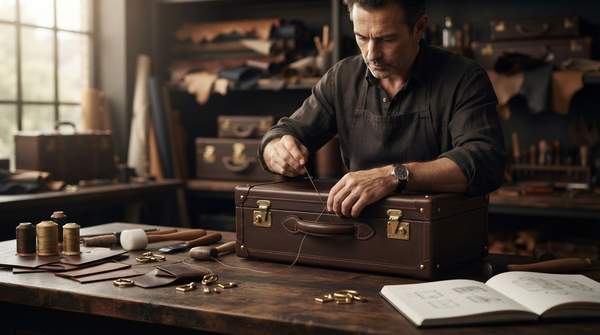
Bespoke leather goods earn their distinction through a sequential, hand-led process: vegetable-tanned hide selected by an artisan, patterns cut by hand, edges skived and beveled, seams closed with the two-needle saddle stitch, and every surface finished and burnished. According to Peter Smith, a UK leather artisan writing for PS Leather Craft, "creating bespoke leather goods is a meticulous process that requires skill, patience, and attention to detail"—and the observable marks of that process are exactly what separate a truly bespoke piece from high-end but mass-produced merchandise.
The Essence of Bespoke: Customization and Craftsmanship
Bespoke leather goods are, by definition, custom-made products tailored to the specific needs and preferences of the customer. Smith describes them as made by artisans who take time to understand the client's style and requirements, producing a one-of-a-kind piece rather than a standardized item. That definition is what positions bespoke work against mass production, even expensive mass production: the difference is not price alone but authorship and fit.
Craftsmanship carries the distinction in practice. Smith notes that artisans attend to every detail "from the selection of the leather to the stitching and finishing touches," and that "there are things that just can't be done in a massed produced environment, which is just one reason why bespoke leather goods are far more expensive." Beyond durability, the bespoke relationship gives the artisan room to advise on design, apply personal style, and choose among mediums—dyeing leather in many ways, or substituting lacing for stitching—so the finished article reflects the owner rather than a market segment.
Stage 1: Material Selection and Preparation
Every bespoke piece begins with the hide, and the tanning method behind that hide shapes everything downstream. Atelier 56, a leather workshop that prioritizes vegetable-tanned leathers "wherever possible," explains the fork in the road: tanning is the pivotal process that preserves raw hides and transforms them into supple, long-lasting leather.
Vegetable tanning uses natural tannins from tree bark and plants, producing firm, richly colored leather that ages gracefully. The workshop notes the process can take weeks, yielding a premium material favored for handmade goods. A tanning-focused account from Walnut Studio adds that authentic vegetable tanning takes a minimum of one month, and that the resulting leather is "carveable, moldable, and structural," natural and breathable with little finishing required—precisely the properties an artisan needs for custom tooling, shaping, and edge work.
Chrome tanning, by contrast, is a modern method using chromium salts. Atelier 56 describes it as quicker, producing softer, more pliable leather, though often less environmentally friendly. A comparison published by The Goods catalogues the trade-offs from the maker's perspective: chrome-tanned leather is quick and inexpensive to produce, stain-resistant, soft, and consistent in color, but it is mass-produced, wears less well, cracks easily, and does not develop patina over time. For bespoke work, those material traits matter as much as aesthetics.
Stage 2: Precision Pattern Making and Cutting
The first act of shaping the leather is the pattern. Atelier 56's account of its workshop practice is explicit that "every piece starts with a precise pattern—hand-drawn or stenciled—that dictates the shape and function of the final product." In bespoke work, this stage is also where the customer's specifications become geometry: dimensions, pocket placement, strap lengths, and hardware positions are drafted for one person rather than adapted from a standard block.
Cutting then translates the pattern into hide with zero tolerance for carelessness. The workshop cuts leather using sharp blades or rotary cutters and stresses that "accuracy is paramount, as errors can be costly." That warning is structural, not rhetorical—leather cannot be re-cut, and a misjudged cut wastes an expensive, weeks-tanned hide. Careful placement of pattern pieces on the hide also lets the artisan read the material itself, working around natural marks and matching grain direction from panel to panel, something an attentive reader can spot in the finished good as consistent grain flow across adjacent pieces.
Stage 3: Skiving, Edging, and Hand-Stitching
Before any thread passes through the leather, the artisan prepares edges and seams. Atelier 56 describes edges as beveled and smoothed for comfort and aesthetics, while skiving thins the leather at seams or folds, "ensuring a sleek finish and adding flexibility." Skived seams are a quiet but decisive quality marker: when a folded edge or joined seam tapers rather than bulges, someone has thinned that leather by hand in exactly the places a machine would not.
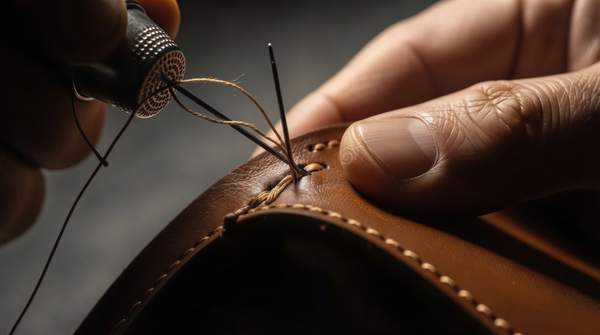
Then comes the technique most associated with luxury handwork: the saddle stitch. Atelier 56 calls hand-stitching "the hallmark of luxury leatherwork," typically performed with two needles working in opposition to create "a remarkably strong and balanced seam, admired for its durability and elegance." The workshop's process discipline is visible in its sequence—quality linen or polyester thread selected for strength and color matching, then stitch spacing marked evenly on the leather before "careful, rhythmic sewing begins." That even, hand-marked rhythm is what gives a genuine saddle-stitched seam its uniform appearance, and it can be examined directly on the finished piece.
Stage 4: Assembly and Finishing Touches
Construction brings the prepared pieces together. Atelier 56's account has pieces joined, often with temporary adhesives holding alignment, followed by the meticulous stitching itself, with high-wear areas reinforced. This is the stage where earlier decisions compound: a precisely skived seam closed with a balanced saddle stitch is both stronger and more elegant than either technique could achieve alone.
Finishing completes the transformation. The workshop burnishes seams to "a smooth, lustrous finish," and Duret Paris's account of luxury bag finishing describes hand-applied work involving multiple layers of specialized dye, gently polished to create "a soft touch and a seamless finish," so that every element integrates with elegance. Smith frames the final result as more than a product: a bespoke piece reflects the owner's personal style while supporting a tradition passed down through generations of makers.
Decision Framework: Identifying True Bespoke Craftsmanship
Use this framework to examine any leather good and diagnose how it was made. Each row correlates a crafting stage with an observable bespoke indicator and the typical mass-produced alternative, drawn from the artisan accounts above. Note one boundary honestly: the evidence supports the bespoke indicators directly, while some mass-produced contrasts—such as edge treatment—are reasonable inferences from the described processes rather than documented specifications.
| Crafting Stage | Bespoke Indicator | Common Mass-Produced Alternative |
|---|---|---|
| Stitching | Hand-sewn saddle stitch with two needles; even, hand-marked spacing; strong, balanced seam | Machine stitching, prized for speed and consistency rather than hand-worked strength |
| Leather tanning | Vegetable-tanned hide: firm, carveable, moldable, develops patina; tanning takes weeks to months | Chrome-tanned hide: quick and cheap to produce, soft, consistent color, but wears and cracks more readily and develops no patina |
| Edges and seams | Hand-skived folds, beveled and smoothed edges, burnished to a lustrous finish | Standardized edges without individual skiving—an inference from the bespoke emphasis on meticulous edge work |
| Personalization | Custom-made to the customer's specifications; artisan contributes design advice and personal style; one-of-a-kind result | Standardized, off-the-shelf designs made for a broad market |
| Production process | Sequential handcrafting: pattern drawn for the client, hand-cut, hand-stitched, hand-finished | Multi-stage production designed for volume and efficiency |
To apply it, inspect the stitching first: angled, uniform hand stitching with visible thread on both faces points to saddle work. Then handle the leather—firm, natural-feeling hide that promises patina suggests vegetable tanning. Finally, ask about the making: a true bespoke maker can describe the pattern, the hide, and the decisions made for you specifically.
Making an Informed Choice: The Value of Bespoke
When commissioning or purchasing luxury leather goods, prioritize items that clearly demonstrate traditional hand-crafting techniques and material choices consistent with bespoke production. The premium is not merely for a name; it purchases a vegetable-tanned hide shaped by a specific artisan, seams that were skived, marked, and closed by hand, and a design drafted for one owner.
The measurable indicator is visible on the product itself: look for the unmistakable rhythm of a hand-sewn saddle stitch, the firm character and emerging patina potential of vegetable-tanned leather, and evidence of custom tailoring or documented artisan involvement in the piece's creation. An item that satisfies those three checks—stitch, hide, and personalization—exhibits the hallmarks of traditional bespoke craftsmanship that no volume production line reproduces.